

In this Everton vs Man United match, I analyse the key tactical moments, individual performances and turning points of the game.
Match that closed the 27th round of the Premier League. Everton had been having a surprisingly stable season. 9th place, balanced numbers (29 scored, 30 conceded) and that classic identity: compact block, physical, few risks. Without Jack Grealish (injured since January) they were losing precisely the player capable of giving composure and creativity between the lines. On the other side, Manchester United were in a good moment under interim Michael Carrick: four wins and a draw in the last five games. A more emotionally stable team and always very dependent on the brain of Bruno Fernandes.
Strong atmosphere at Hill Dickinson. In the very first minute, Lammens almost made a mistake playing out from the back. In the 3rd minute, a chaotic situation in Everton’s box: shots, blocks, the ball almost going in, Pickford saving and Tarkowski clearing near the line. Pure table football. But apart from that moment, not much else.
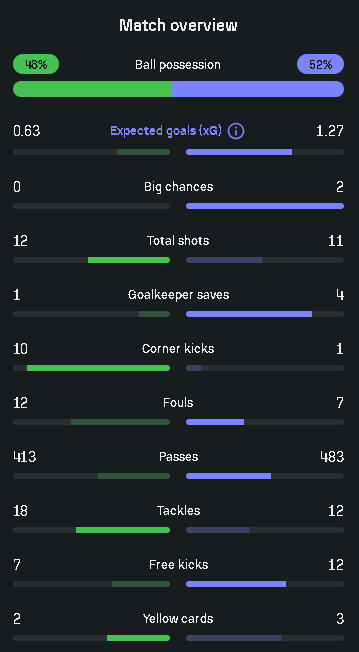
United had the ball, but had no ideas. They circulated possession, tried to go down the flanks, but lacked sharpness. Dalot still tested Pickford, there was a well-worked move in the 20th minute, but creativity was below normal. Cunha, Diallo, Mainoo… all a bit disconnected. And Everton, even with less possession, seemed more comfortable in their plan. They closed central spaces well and when they advanced up the pitch, gave the feeling of greater danger, even if statistically they created almost nothing. They clearly lacked a midfielder capable of taking risks through the central corridor.
At the end of the first half, the feeling was strange: United had more of the ball and more shots, but looked less comfortable. Everton grew in the final minutes before the break and left the idea that the game was completely open.
The second half starts better for the home side. Armstrong forces Lammens into a save in the 46th minute. United continued without rhythm. Wrong decisions, poorly measured passes, Cunha overdoing the dribble when the pass to Šeško was obvious in a clear counter-attack in the 66th minute. There was a lack of objectivity.
The introduction of Benjamin Šeško changes the game. In the 71st minute, finally a clean and well-executed move. Cunha releases it into depth, Mbeumo delays intelligently and serves Šeško in the box. First-time finish, placed, 0-1.
The problem is that United didn’t kill the game. Everton believed. They pushed their lines up, brought on Beto to add physical presence and started to force the issue. In the 82nd minute, Keane strikes powerfully towards the top corner and Lammens responds with a great save.
It was a night of poor decisions from United on the ball. Too rushed at times, too slow at others. There was still a counter-attack in stoppage time that Šeško could have finished better, and a long-range shot at the very end that once again forced Lammens into action. The result remained.
Post-match
Important win, but not convincing. United continue to collect points under Carrick and at this stage of the season that is what matters most. But this game reinforces an idea: against compact blocks, when they are clear favourites, the team struggles to speed up the game with creativity.
Bruno didn’t have his usual impact, many players below their level and it was down to efficiency and Šeško’s decisive introduction.
For Everton, a defeat that does not embarrass them. Competitive, organised and pushing until the end. They lacked individual quality to unlock it.