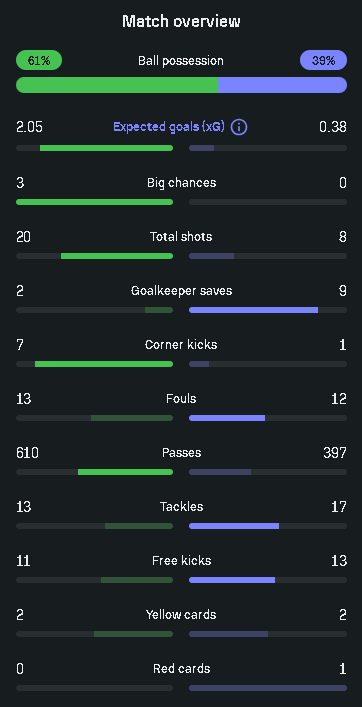


In this Man United vs Crystal Palace match, I analyse the key tactical moments, individual performances and turning points of the game.
Old Trafford felt that the night could change the course of the season. Manchester United stepped onto the pitch knowing that Aston Villa’s slip was not just a curious result of the round: it was a real opportunity. Win and officially move into 3rd place in the Premier League. On the other side, a Crystal Palace living a more irregular season, but with enough quality to punish any distraction.
Right at the start, from a set piece, one of this United’s structural problems became clear: emotional fragility when something escapes the plan. Corner, permissive marking, Lacroix wins in the air far too easily and Lammens barely reacts. 0-1. It wasn’t just a goal conceded.
United’s reaction was neither immediate nor organised. There was possession, yes. There were attempts to accelerate, too. But everything felt forced, unnatural. Bruno Fernandes tried to drop deeper to take control, Mainoo looked to connect sectors, but there was a lack of fluency. The flanks were not synchronised, Cunha complained about passes not arriving, and the feeling was of an anxious team.
Palace, comfortable in a mid-block, explored the wide spaces and showed that United were not defensively secure.
As the minutes passed, United began pushing Palace back. More set pieces, more crosses, more presence in the box. Henderson started appearing more often in the broadcast frame. Bruno forced him into a save from a dangerous free kick and Casemiro had an aerial chance that could have changed the first half’s outcome.
The second half brought a different intensity. Not necessarily better football, but more urgency. In a duel inside the box, Lacroix holds Cunha. The referee points to the penalty spot. For me, it’s a borderline interpretation. Is there contact? Yes. Is it enough for the fall? Debatable. But in modern football these holds inside the box are always subject to this outcome. What feels excessive to me is the red card.
Bruno steps up. Total composure. Ball one way, Henderson the other. Equaliser and numerical superiority. And from there, the scenario changes radically.
With the extra man, United finally find space. When there is space and Bruno has time to decide, something happens. The cross to Šeško is perfect and the header comes with class. It’s not just power, it’s technique, it’s placement. 2-1. And at that moment, you feel the game is emotionally decided.
Palace tried to resist, Henderson still prevented a third goal with two great interventions, but there was no longer structure nor energy for a consistent response.
Post-match
Important win, but not totally convincing. Manchester United showed the ability to react and the maturity to take advantage of the numerical edge, but once again revealed defensive fragilities and moments of disorganisation. The creative dependence on Bruno Fernandes remains evident and when he grows, the team grows; when he disappears, the team is left without ideas.
Crystal Palace competed well while they had eleven men, were disciplined and knew how to exploit the opponent’s insecurities. The game turns on a detail and that detail weighs heavily.
In the end, three points worth more than just table position. United may not always be brilliant, but they are beginning to build that mentality of a team that finds a way to win even on less inspired days.