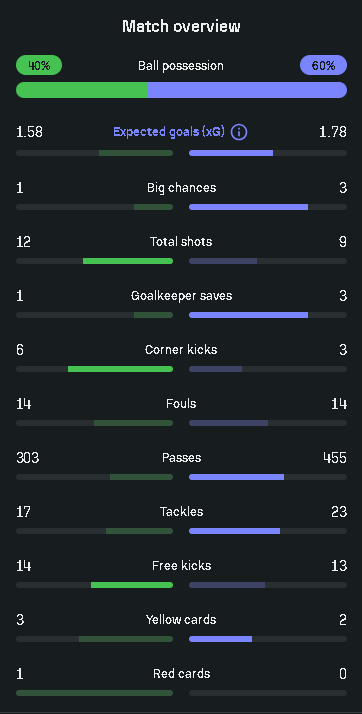


In this Tottenham vs Crystal Palace match, I analyse the key tactical moments, individual performances and turning points of the game.
The atmosphere at the Tottenham Hotspur Stadium is no longer one of expectation, it is one of impatience. Tottenham stepped onto the pitch with that heavy feeling of a team that knows the season is completely slipping out of control. On the other side, Crystal Palace are not having a great year either.
Curiously, Palace started better. In the very first minute, Adam Wharton appeared free inside the box and forced Vicario into action with a powerful shot straight down the middle. It was a clear warning of what would follow. Palace took control of possession, calmly moving the ball around, while Tottenham seemed more concerned with closing spaces than actually pressing.
Mathys Tel still tried something different, beating two defenders and getting into the box, but the finish did not match the quality of the run. In fact, for much of the first half, Tel was practically the only Spurs player who seemed capable of breaking lines.
The overall feeling was strange: two teams lacking attacking inspiration, but with Palace controlling more of the game. Tottenham looked stuck in very predictable football, without collective dynamism. At one point I even remembered the phrase from journalist Fred Caldeira, who said earlier today that Tottenham might currently be playing the worst football in the Premier League. And watching this first half, it is difficult to say that is an exaggeration.
Palace even found the net in the 30th minute, but VAR intervened and ruled it out for a millimetric offside.
A few minutes later, Tottenham found something that seemed unlikely: inspiration. In the 34th minute, Archie Gray practically created a move on his own down the right side, beating two opponents and reaching the byline before cutting the ball back into the six-yard box. Solanke, positioned like a true number 9, pushed it into the net. 1-0.
In the 37th minute, Van de Ven pulled Ismaïla Sarr inside the box just as the winger was about to go through on goal. The referee did not hesitate: penalty and a red card for the Spurs captain. A heavy decision, but difficult to argue against. In the 39th minute, Sarr himself converted the penalty and levelled the match.
Already in stoppage time, at 45+2, Adam Wharton played a perfect ball behind the defence and Jørgen Strand Larsen timed his run to finish between Vicario’s legs. The comeback was complete.
But there was still time for another blow. At 45+7, once again Wharton, with an absolutely delicious pass, released Ismaïla Sarr in behind the defence. Vicario hesitated coming out, the centre-backs paused, and the Palace winger took advantage to score the third.
The second half began with a curious detail: Tottenham looked more organised with ten players than they had with eleven in the first half. Early on, Danso forced Dean Henderson into a good save with a dangerous header. Archie Gray continued to be one of the few trying something different, and Mathys Tel also remained active, searching for imbalances. They were two points of light in a very dull collective.
Palace, meanwhile, did what mature teams know how to do. With the lead and an extra player, they began to manage the rhythm. They did not need to dominate possession overwhelmingly. Even so, there were moments of danger. In the 68th minute, Solanke received the ball inside the box, cut inside and tried to surprise Henderson at the near post. The English goalkeeper was alert and made a solid save.
It is March, and Tottenham have still not managed a single Premier League victory in 2026. For a club of this size, it is an almost surreal scenario. Tottenham, are you going to say hello to Millwall?
Post-match
A very competent victory for Crystal Palace. It was not an extraordinary attacking spectacle, but it was an organised, patient and efficient team at the right moments. Adam Wharton was clearly one of the protagonists, with two decisive passes that completely dismantled Tottenham’s defence.
Tottenham, on the other hand, are living through a deeply worrying moment. The team looks without identity, without confidence and without creative solutions. Even when there are good individual moments, like those from Gray or Tel, it does not translate into consistent football. Did Van de Ven’s red card complicate the game? Yes, but the reality is Tottenham were already being dominated before that.
The final result, 1-3, ends up reflecting a scenario that has become far too familiar for Spurs fans this season: frustration, empty stands before the final whistle and a team that seems increasingly lost on the pitch.