

In this Celta de Vigo vs Real Madrid match, I analyse the key tactical moments, individual performances and turning points of the game.
St. Balaídos hosted one of those games that, looking at the table, can no longer be treated as routine for Real Madrid. Celta de Vigo arrive at this stage of the season in a position few would have imagined some time ago: 6th place and competitive football. On the other side was a pressured Real Madrid. Two consecutive league defeats, four points behind Barcelona and a squad completely patched together. Even so, it must be said: Real Madrid still have a better squad than almost everyone else in the league. The problem is not talent, it is the collective.
The start of the match reinforced the idea of balance. Celta entered comfortably. Courtois had to intervene early to avoid bigger problems. On the other side, it took just one move for Real Madrid to show danger: Vini Jr burst between the centre-backs and hit the post, a reminder that even with an irregular collective, the team still has players capable of deciding games on their own.
Shortly after came the first blow. From a short corner, Arda Güler released the ball to the edge of the box and Tchouaméni appeared completely free to strike first time. A well-hit shot, but also an obvious defensive error from Celta for leaving a midfielder alone in that area.
Iglesias tested Courtois again after a good run in behind and the feeling was strange: the team that was playing better was the one losing.
The equaliser eventually arrived naturally. Swedberg appeared down the left, Arnold defended the situation poorly and ended up giving the Swedish winger space and time. The pass went into the middle of the box and Borja Iglesias only had to push it into the net.
Without someone to pin the centre-backs or attack crosses, many Real Madrid attacks ended before truly threatening. It was a Madrid that even seemed comfortable defending and waiting for space to run into. It is a possible approach, of course. I even believe that at some point Real Madrid wanted that, but then they were “forced” to have the ball.
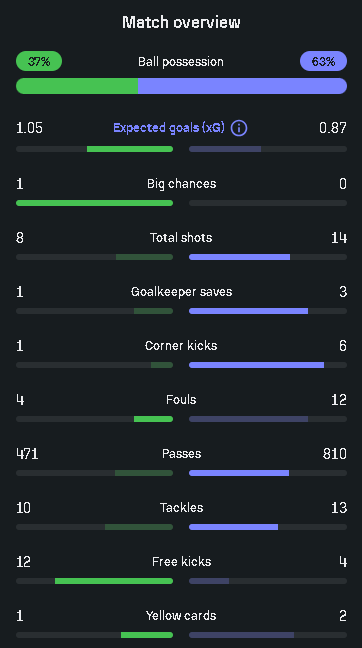
Until half-time, the player who worked the most was Courtois. Swedberg threatened again and the Belgian goalkeeper had to rescue a defence that was giving far too much space for shots. The half-time statistics summed up the game quite well: more dangerous shots from Celta, more real threat, and a Madrid side that had done little with the ball.
The second half began with a small scare that summarised some of the limitations in Madrid’s current squad. Raúl Asensio again showed insecurity in a simple situation and, honestly, the criticism he receives for not being at Real Madrid level seems difficult to argue against. The problem is that, with so many injuries, there are not many alternatives either.
Real Madrid had more possession, more presence in the attacking half and spent more time installed in the opponent’s field, but without really creating clear situations. Without space to run and without a reference inside the box, many moves ended in blocked shots or attempts from distance.
The most debatable moment of the second half came around the 70th minute. Honestly, there is doubt. The arm rises clearly and it is one of those situations where you see referees give it both ways. It would not have been outrageous to award a penalty there.
Meanwhile, Celta disappeared offensively. The team that had been positive in the first half spent much of the second period defending deeper. Madrid had the ball, but also seemed trapped in a predictable attack.
Even so, football is rarely linear. Near the end, Celta had perhaps the best chance of the second half: a quick counter-attack, the ball to Iago Aspas inside the box, a fake shot to beat the defender and a strike off the post. It was the kind of moment that could have decided the game right there.
When a draw seemed the inevitable outcome, the final moment arrived. A low cross, an incomplete clearance from the Celta defence and the ball fell to Valverde. The Uruguayan struck first time and the ball still deflected off a defender, completely changing its trajectory and deceiving the goalkeeper. One of those chaotic goals that football also produces.
Post-match
Real Madrid leave Vigo with three important points, but the feeling remains of a team that lives much more from moments than from clear collective dominance. It was not a particularly convincing performance, but it was effective in the decisive moment.
For Celta, there is a bitter feeling. The team showed courage in the first half, personality and managed to compete. There were moments where they looked more comfortable in the game than Madrid themselves, but they lacked the ability to turn attacking presence into goals.
In the end, Real Madrid did what they so often do: find a moment that decides everything. It does not resolve the doubts about the team, but it keeps them alive in the fight at the top of the league.