

In this Forest vs Aston Villa match, I analyse the key tactical moments, individual performances and turning points of the game.
First leg of an all-English semi-final and, on paper, everything pointed to an intense match, very much in the Premier League mould. But the reality was different: a more closed, more calculated game and, at times, surprisingly flat.
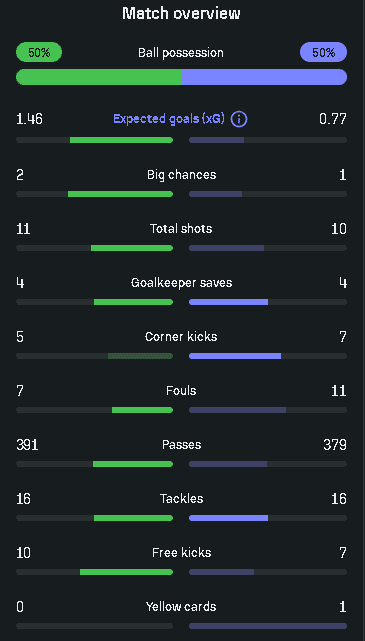
The start actually suggested otherwise. Aston Villa came out better, freer, more dangerous. In the opening minutes, they looked more comfortable and closer to scoring, but it didn’t last. As time went on, Forest grew into it, pushed higher and started to see more of the ball. But there was a clear issue: having possession doesn’t mean knowing what to do with it. They moved it around, circulated, but couldn’t find real openings.
Villa, on the other hand, accepted that scenario. They dropped deeper, stayed compact and waited for transition moments. And when they broke, they did create some danger. In the 28th minute, from a well-worked counter, the ball reached the right, Morgan Rogers set himself and struck a placed shot that forced a good save. But those were isolated moments, there was no continuity.
The game slipped into a strange rhythm. No one truly accelerated. No one seemed urgent. Forest had more possession, but no aggression. Villa defended well, but didn’t force mistakes either and that reflected in the chances: few, spaced out and rarely dangerous. There was a good save from Martínez to prevent a goal, but beyond that, very little to really impact the match.
At half-time, the feeling was clear: balanced, but poor.
The second half followed a similar pattern, with small signs of life. Villa had one of the best chances of the game when Watkins found himself in the six-yard box with everything to score… and missed. Missed in a way that’s almost hard to explain. It just needed a clean finish.
And when games like this aren’t decided in those moments, they tend to be settled by something else. In the 67th minute, a ball into the box, a recovery attempt near the byline and a completely unnecessary action from Digne. He raises his arms for no reason and the ball hits his hand. Not clearly intentional, but unnatural. VAR intervenes and the referee points to the spot. Correct decision.
In the 71st minute, Chris Wood steps up and doesn’t hesitate. A composed, well-placed finish, no chance for the keeper. 1-0. At that point, you expected a strong reaction from Aston Villa, but it never came.
They tried to push higher, had more of the ball, but lacked intensity, lacked urgency. It’s strange to see a team losing in a semi-final and still unable to truly pin the opponent back. The minutes pass and nothing changes: sideways passes, little aggression, little pressure. Forest, comfortable, even end up having more of the ball than expected at that stage.
And that says everything about the match. In the end, it’s not so much about who was better, but who took advantage of the one clear mistake.
Post-match
Forest take the advantage and, more than that, confidence. Aston Villa leave a strange impression. In a semi-final, far more urgency was expected.