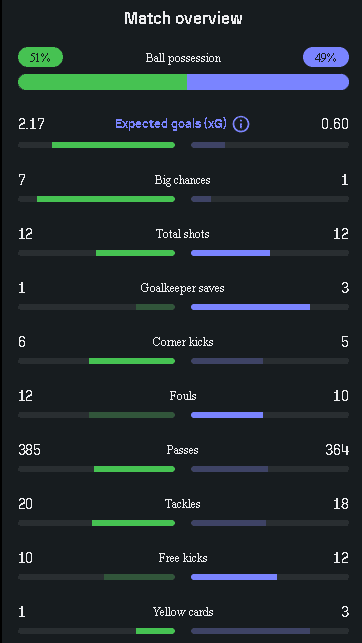


In this Al Qadsiah vs Al Nassr match, I analyse the key tactical moments, individual performances and turning points of the game.
There was a clear narrative before the match: a long winning streak, high confidence, a sense of total control from Al Nassr. But football has its moments, and sometimes, when the pressure peaks, everything breaks. The start seemed in line with expectations. Al Nassr had more of the ball, more presence, trying to take control, but it was empty possession, slow, with no penetration. They circulated, they passed, but they did not hurt.
On the other side was an Al Qadsiah side far more comfortable in the match. More intense, more direct, more dangerous whenever they accelerated, and that became evident early on, with quick transitions and balls in behind creating problems.
Then, in the 24th minute, the first blow. A mistake in the build-up, a preventable loss of possession, and Al Qadsiah punished it. The ball went wide left, a well-measured cross, and Mohammed Abu Al-Shamat attacked the space with perfect timing to finish. A simple goal, but one that came from everything Al Nassr were doing wrong. 1–0. And the truth is, the goal did not change the pattern. Al Nassr remained lost. A disconnected midfield, no real pressing, and players always a second late.
Still, there is talent. And sometimes, talent solves things. In the 41st minute, finally a move with purpose. Brozovic carried the ball down the left, lifted his head and played a driven pass into the area. Félix was free and finished with power and precision, leaving no chance. 1–1.
An equaliser that did not truly reflect the match… but it gave Al Nassr a lifeline. The problem was, it did not last long.
The second half began, and it quickly became clear that Al Qadsiah were still the better side. More aggressive, more switched on, and more prepared to punish mistakes.
And it came again. In the 55th minute, Brozovic lost the ball in midfield, a quick transition followed, the advantage was well played, and the ball reached Musab Al Juwayr inside the box. With no pressure, he simply tapped it in. It was almost a replay of the first goal: mistake, space, immediate punishment. 2–1. And here, contrary to what might be expected, Al Nassr did not react. No urgency, no real pressure, no intensity. There was frustration, but very little response.
The match drifted on with the same feeling: Al Qadsiah looked closer to a third than Al Nassr did to an equaliser. And in the 78th minute, that was confirmed. A low cross, chaos in the box, a poor clearance, defensive confusion, and the ball fell to Quiñones. When the ball drops to a striker like that, it is usually over. A simple, direct, efficient finish. 3–1.
At that point, the game was done, because Al Nassr had nothing left to give. Not physically, not emotionally, not tactically. It was an unrecognisable performance. Slow, disconnected, without ideas, and in a match like this, that is punished heavily.
Post-match
A heavy defeat, not just because of the result, but because of the manner of it. Al Nassr failed in one of the most important moments of the season and raised serious doubts.