
 · 2 min read
In this Atletico vs Man United match, I analyse the key tactical moments, individual performances and turning points of the game.
Manchester United came into the second matchday of the Champions League after beating Sabah, while Atlético were coming off a defeat against Liverpool. Even so, the Spanish side were favourites, not because they’re an unstoppable team, but because United are still going through a disastrous spell, with poor performances and a manager who has struggled to understand what the game is asking of him. And it took just 45 seconds to start seeing why.
Baena received the ball on the right, looked up and picked out Barrios, who was completely unmarked and struck it first time. Heaven tried to block the shot, but the ball went through his legs and into the net. Far too easy, with far too much space in a defence that once again showed its weaknesses right from the start.
United tried to respond. Mbeumo produced an excellent individual run in the 13th minute, nutmegging Romero before shooting just wide of the far post. Shortly afterwards, Rashford was played through into the box but completely missed the ball.
In the 24th minute, Mbeumo was involved again, this time combining with Tielemans and forcing Oblak into a save. Interestingly, despite having much less possession, United were managing to create some danger. Atlético controlled the ball, but weren’t exactly dominating the chances.
The problem also lay in the English side’s attacking organisation. Carrick put Bruno Fernandes out on the right, but the experiment wasn’t working. Bruno still produced a good individual run in the 39th minute, only to take far too long to decide what to do next. Meanwhile, the game had lost its intensity, with few shots and long spells without any real danger.
In the 43rd minute, Atlético even scored again through Johnny Cardoso, but the goal was ruled out for a handball by Llorente. The incident once again exposed a United defence incapable of protecting a dangerous area just outside the box.
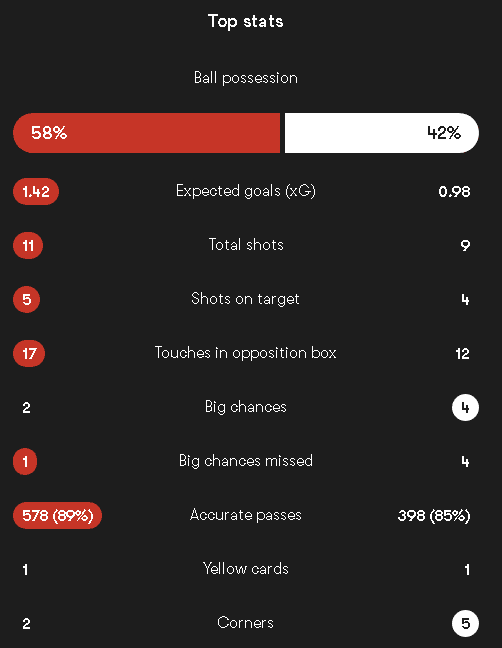
At half-time, the numbers actually gave United some reason to believe they could fight back: 0.68 expected goals compared to Atlético’s 0.27. But one change was obvious. Bruno on the right wasn’t working, and something had to be done about it. The most frustrating part was coming out for the second half without making a single change.
In the 55th minute, Barrios used a body feint to get past his opponent and crossed for Álvarez, who hit the post. United threatened too, with Bruno trying to lift the ball over Oblak and seeing it pass narrowly wide of the post on a counter-attack. But Carrick still made no changes. It wasn’t until the 65th minute that Diallo, Mount and Zirkzee came on. Bruno finally moved into the middle, Mbeumo shifted to the right, and the team took on a more attacking shape. It was the adjustment they needed, but it came too late.
Bruno even hit the crossbar in the 70th minute with an excellent shot from a rehearsed corner routine. However, United’s desperate search for an equaliser left them exposed.
Yoro brought down Jonathan David as he raced through on goal, was sent off in the 74th minute and left his team in an almost impossible situation. Five minutes later, David shot, Lammens saved, and substitute Lookman reacted quickest to the rebound to make it 2-0.
The sending-off affected the closing stages, but it doesn’t erase the problems that came before it. United once again struggled with their defensive organisation, took far too long to correct Bruno’s positioning and only reacted when they were already backed into a corner.
Post-match
In my opinion, Carrick is no longer providing answers. And right now, United’s problems go far beyond losing an away game.