
 · 2 min read
In this Dortmund vs Werder Bremen match, I analyse the key tactical moments, individual performances and turning points of the game.
Dortmund came into the third round of the DFB-Pokal as clear favourites, with Niko Kovač stabilising the team and making them competitive again. Even so, Werder Bremen were enjoying a historic start to the season under Daniel Thioune. There were reasons to respect the opposition, but at home, Dortmund had a duty to progress.
The game kicked off a few minutes late because of smoke in the stands, which at one point completely obscured the view. Once play finally got underway, Dortmund needed just six minutes to score. On the counter-attack, Bellingham played Beier through on the left, and he sent a low cross towards Ryerson. The full-back got a slight touch and Guirassy, well positioned, finished from close range. Dortmund’s first shot, Dortmund’s first goal.
Kovač’s side were playing with fluidity, pressing well and giving Bremen no room to breathe. The second goal arrived in the 17th minute. Veerman crossed for Jobe Bellingham’s run into the box, and he won the aerial duel. The ball fell to Chukwuemeka inside the area, whose low shot was saved by Karl Hein, but not well enough to prevent the goal. The goalkeeper could clearly have done better. Dortmund looked set for a comfortable evening.
Bremen only started creating danger after the half-hour mark. Grüll appeared on the left and shot narrowly wide, one of the visitors’ first signs of life. Despite enjoying a few spells with more possession, they continued to struggle badly to make progress. Dortmund closed down the spaces and frequently forced their opponents back towards Hein. At half-time, the two-goal lead was deserved, particularly given their pressing and ability to play in the attacking half.
The picture changed in the second half, however. Bremen came out more aggressively and began finding space. Kobel had to deal with a header from Itten, while Nmecha responded for Dortmund with a dangerous shot. Chukwuemeka also wasted an excellent chance to make it three after failing to control the ball properly inside the box.
In the 59th minute, Thioune took a gamble with four substitutions, including Niclas Füllkrug’s return to Signal Iduna Park, this time as an opponent. The move couldn’t have worked out better. In the 64th minute, Ryerson clearly pulled Schmetgens by the arm inside the box, and the referee awarded a penalty. Füllkrug converted calmly, sending Kobel the wrong way.
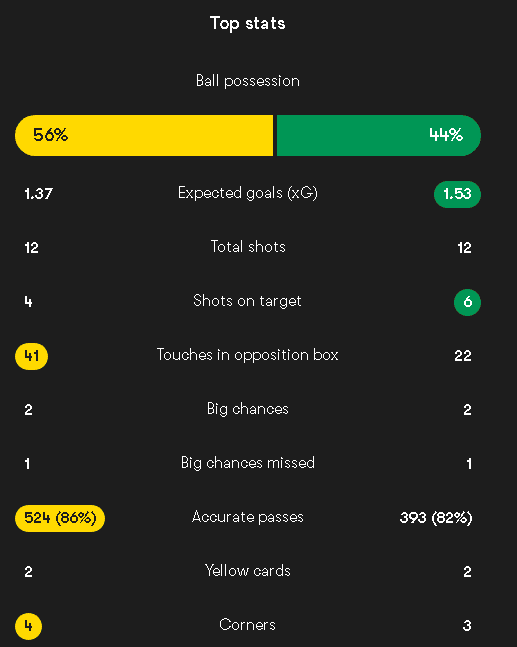
Three minutes later, the striker scored again. After producing a brilliant nutmeg on Anton, he found space, drove into the box and shot into the corner. Two goals in a matter of minutes against his former club. Bremen were back in the game, and Dortmund looked completely lost. The team that had dominated the first half had disappeared, failing to get even a single shot on target in the second.
Bremen threatened to complete the comeback, while Dortmund only began pushing their opponents back again in the closing minutes. Just when extra time seemed inevitable, Nmecha won a dangerous free-kick deep into stoppage time. Sabitzer stepped up and scored a superb goal, catching Hein by surprise, as the goalkeeper seemed to be expecting a cross.
What a way to avoid extra time! Dortmund won, but sent out a serious warning: after a very competent first half, they nearly threw everything away.
Post-match
Füllkrug turned the game on its head almost single-handedly for several minutes, but Sabitzer ultimately saved the night with a moment of outstanding quality.