
 · 2 min read
In this Forest vs Arsenal match, I analyse the key tactical moments, individual performances and turning points of the game.
Some games are all about getting the win. And then there are games where, on top of winning, you have to wonder how a team like Arsenal can make a match so difficult to watch. On matchday seven, the London side travelled to face a Nottingham Forest team in crisis, with just one win from six games and two consecutive defeats. With Manchester City top of the table, dropping more points this early in the season wasn’t an option. Nobody was asking for a spectacle. They were asking for a win.
Arsenal had the ball from the start, but that didn’t mean much. Forest set up in a compact 5-4-1, without dropping their defensive line too deep, and managed to close off the central spaces. In the 16th minute, Saka won a free-kick from Neco Williams, who was booked, but even that advantage seemed insufficient to break the deadlock.
The first serious threat came from the other side. In the 18th minute, a mistake from Calafiori allowed Ndoye to shoot, forcing Raya to turn the ball behind for a corner. Arsenal continued to dominate territory in the opposition half, but lacked the ideas to turn possession into chances. They mainly looked to attack down the right, through Eze and Calafiori, while the other flank barely featured.
In the 26th minute, a corner caused some confusion in the Forest box. Calafiori headed the ball backwards and Gabriel tried to finish with a backheel, facing away from goal, but ended up hitting his own teammate Konsa, who could do little to avoid blocking the attempt. It was perhaps the most bizarre moment of a very poor first half.
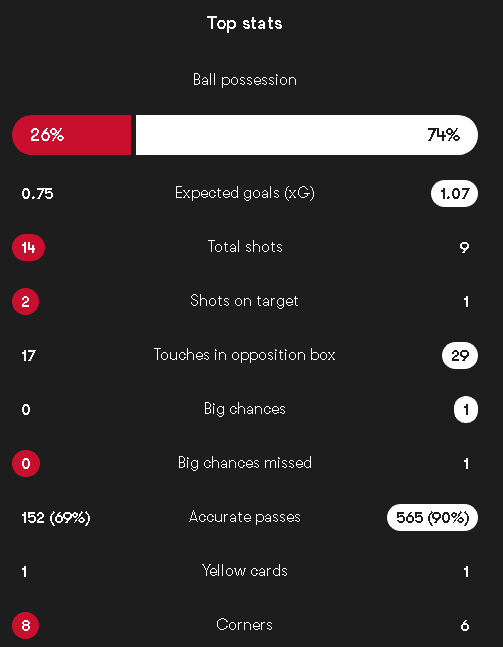
And that’s no exaggeration. At half-time, neither team had managed to hit the target. Forest had five shots, Arsenal just three, and most of the danger came from set-pieces or individual errors. The possession stats, with 74% for the visitors, concealed an obvious problem: having the ball isn’t the same as knowing what to do with it.
The second half brought no immediate change. Madueke came on for Eze and had to play on the left, but Arsenal still couldn’t find any clear solutions. At the other end, Forest kept trying long balls towards Liam Delap, with little success. The striker provided a focal point up front, but lacked the quality to turn those passes into a consistent threat.
In the 54th minute, Murillo finally managed the first shot on target of the match, following a corner. More than an hour into the game, and Arsenal still hadn’t forced the opposition goalkeeper into a save. That is nowhere near good enough for a team with these ambitions.
In the 66th minute, Arteta brought on Timber, Gyökeres and Merino, finally looking to change the game. Five minutes later, Timber reached the byline on the right and found Rice in space inside the box, but his shot flew well over the bar. It was Arsenal’s first genuinely interesting chance from open play.
The goal finally came in the 80th minute, almost as a relief. Madueke received the ball on the left, cut inside and shot. The ball took a deflection off a defender and wrong-footed the goalkeeper, putting Arsenal ahead. It wasn’t a brilliant move, but at that point, nobody in London was going to complain about how it went in.
Forest still tried to respond, but Rice stopped a potential chance for Chris Wood in the 89th minute.
Post-match
Arsenal did the bare minimum and took all three points. However, winning doesn’t erase everything: a team that wants to keep pace with City has to show far more than this.