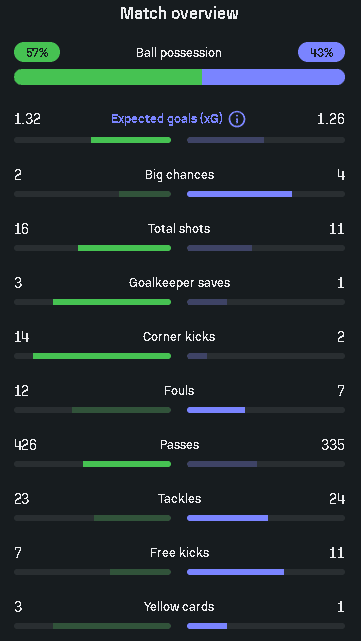


In this Tottenham vs Leeds match, I analyse the key tactical moments, individual performances and turning points of the game.
There are games where the pressure weighs more than the football itself, and this was one of them for Tottenham.
They started with possession, with intent, with more control of the ball. Tottenham tried to take charge, tried to push Leeds back, but the problem became obvious very quickly: lots of volume, very little efficiency. The ball moved around, crosses came in, corners appeared, but real danger? Almost none. Leeds, comfortable in their block, defended well. Back five, organised, patient. And when they recovered the ball, they tried to break quickly. Not always well, but with a clear idea.
At 21’, the first major warning. Joe Rodon rose well from a corner and powered a header towards goal, but Kinský produced an incredible save on the line. A moment that could have changed the game, but did not.
And that summed up much of the first half. Tottenham had more of the ball, more territorial presence, but lacked the creativity to break Leeds down. Richarlison got involved a few times, but his decisions were poor. In one moment inside the area, his shot was weak. In another, completely unmarked, he produced a finish with no quality. Tel at least tried to offer something different, with dribbles and carries down the left side, but everything ended up blocked or poorly finished.
On the other side, Leeds gradually grew in confidence. They did not dominate, but they started to balance the match. There was even a moment involving Calvert-Lewin close to half-time that could have led to a penalty, but the offside flag stopped everything by the smallest margin.
And by half-time, the feeling was clear: Tottenham wanted to, but simply could not.
The second half began and finally something changed.
At 50’, from a corner, the ball was cleared and fell to Tel outside the area. With no pressure on him, he set himself and curled a beautiful strike into the far top corner. A brilliant goal. 1-0. Pure relief around the stadium. One of those moments that unlocks a difficult game.
And from there, you expected Tottenham to become more relaxed, more confident, but that is not what happened. Leeds reacted well. They pushed higher, started to have more of the ball, more presence and Tottenham once again fell into a passive, reactive game.
Then came the decisive moment. At 69’, the ball dropped inside the area and Tel tried to clear it, but overcomplicated things. He attempted an unnecessary bicycle kick and caught Ampadu in the face. Clear penalty. Correct decision. At 74’, Calvert-Lewin stepped up. Powerful finish, perfectly placed, no chance for Kinský. 1-1. Everything reset, but now with Tottenham under even more pressure.
The most surprising thing was the reaction. Or rather, the lack of one. Tottenham could not create anything. No ideas, no connections, no constant presence in the box. Leeds, on the contrary, kept growing. They believed. And they actually looked closer to winning it.
Then came the astonishing 13 minutes of added time, and the game completely opened up. At 90+8’, Longstaff appeared inside the area, struck powerfully and Kinský made an outrageous save, with the ball then crashing against the crossbar. Moments later, Longstaff missed again in unbelievable fashion, not even hitting the target.
Tottenham still tried to push at the end and appealed for a penalty in one final chaotic moment, but the decision was correct: clean tackle.
And that was how it ended. A game where Tottenham started better, but never managed to emotionally control things once they went ahead.
Post-match
A draw that feels disappointing for Tottenham and honestly could have been worse. The relegation battle remains completely open.